
Emergency Gate Repair Near Me: What Rowlett Homeowners Should Do First
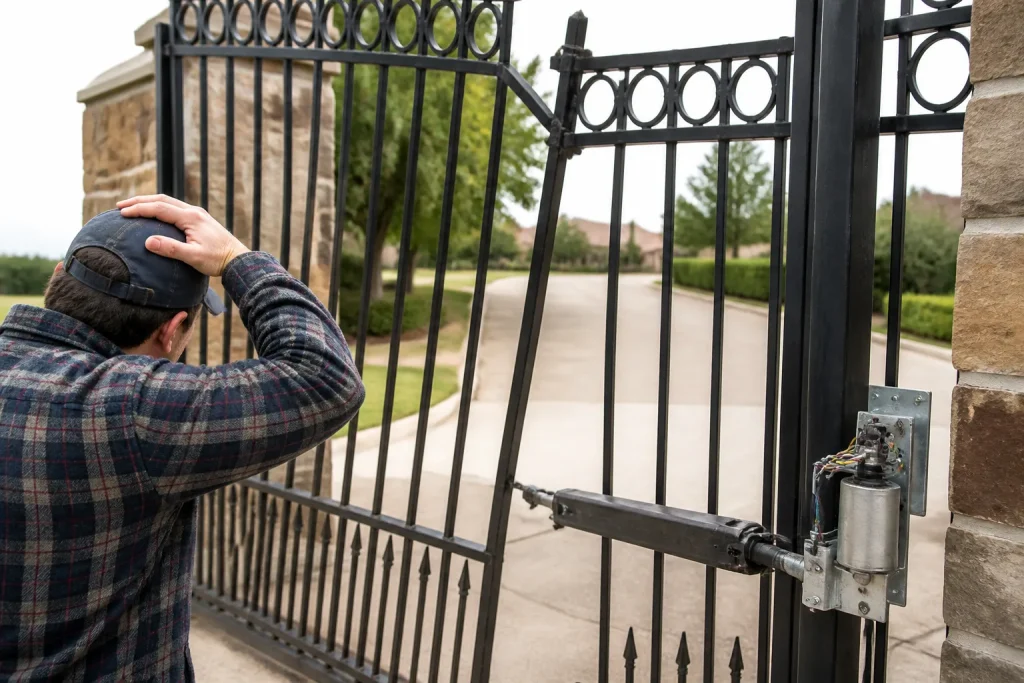
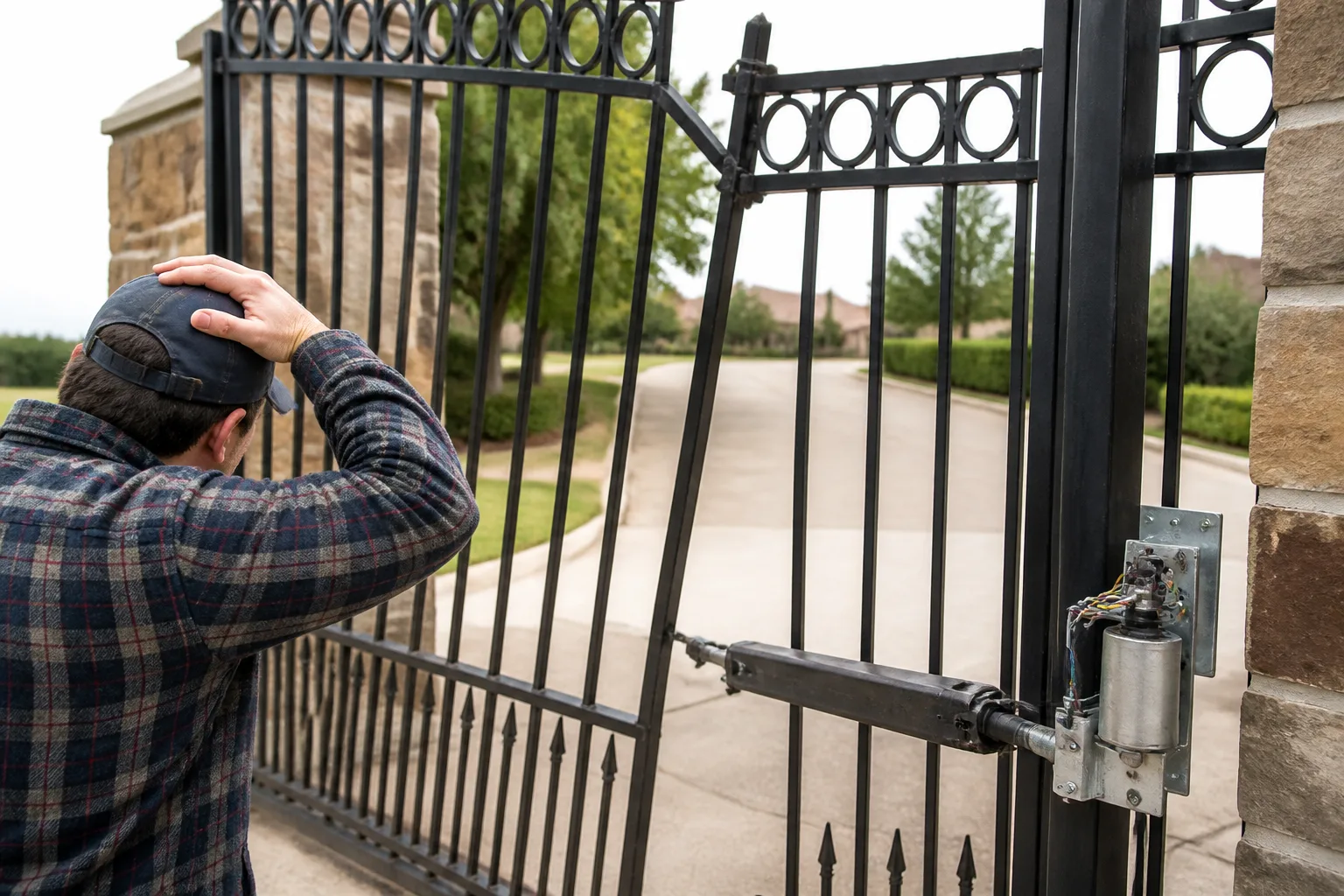
The first thing to do when your gate fails in Rowlett is stop touching it. Don’t force the operator through another cycle. Don’t shove the gate leaf along its track by hand. Don’t disconnect the arm from a swing gate and drag it open with your vehicle unless you know exactly where the manual release is and how it engages. Most emergency calls we run involve a repairable fault that became a replacement job because someone tried to muscle a jammed mechanism past its stop point in the first five minutes.
If you’d rather skip the stress and have someone who knows these systems inside out take it from here, call us at (877) 265-5743. We’ll walk you through the safe move over the phone before we even dispatch a truck.
Why the First Five Minutes Matter More Than the Repair Itself
The highest-risk window after a gate failure isn’t the hour it takes a technician to arrive. It’s the period before you make that call. A gate that stops mid-cycle has usually tripped a safety input, overheated a thermal limiter, or detected an obstruction. The operator is doing what it was designed to do: refusing to run until the fault clears. Forcing it past that refusal is how a $30 sensor alignment turns into a burned-out motor or a stripped gearbox.
We’ve pulled operators out of Rowlett garages where the homeowner cycled the system a dozen times in three minutes, each attempt grinding the drive gear a little further into the housing. By the time we arrived, the fault was obvious on the bench, but the damage was done. The repair cost quadrupled, and the gate was down for three extra days waiting on parts.
Manual gates fail differently, but the same restraint applies. A gate that’s dragging on its hinges or hanging low on a slide track is telling you something about weight distribution, bearing wear, or a shifted post. Muscling it through its travel arc bends the hinge leafs, scores the track, and puts load on welds that weren’t designed for it.
Swing Gates vs. Slide Gates: The Safe Manual Release
Every automated gate operator has a manual release mechanism, and the safe procedure differs by gate type. In Rowlett we see mostly residential swing gates and a fair number of slide gates on larger lots, so here’s what actually works without damaging the drive.
If you have a swing gate:
- Locate the release handle. On LiftMaster, FAAC, and BFT swing operators it’s typically a small pull-chain or a red lever on the underside of the operator housing. On Viking and Ghost Controls systems it may be a keyed release cylinder on the side of the body.
- Pull the release to disengage the geartrain before you touch the gate leaf. This is the step most homeowners skip. The gate will not move freely if the operator is still mechanically linked, and forcing it is what strips gears.
- Move the gate by hand slowly. If it resists at any point in the arc, stop. That resistance is information. It tells you whether the problem is in the gate hardware itself rather than the operator.
- Re-engage the release when the gate is where you want it. A disengaged swing gate is a liability in the wind. Rowlett gets enough gusts off the lake that a free-swinging leaf can slam hard enough to crack a hinge weld.
If you have a slide gate:
- Look for the release on the drive unit, not the gate. Linear and DoorKing slide operators have a hinged cover on the gearbox with a release knob or handle inside.
- Turn or pull the release until the drive cog separates from the rack. You’ll usually feel it disengage.
- Slide the gate with one hand on the frame, not the pickets. If it jams halfway, don’t shove harder. A slide gate that stops mid-track is often on a broken roller or a bent rail, and forcing it will snap more rollers and potentially drop the gate off the track entirely.
The key distinction: a swing gate moves through an arc and stores energy in the hinge assembly. A slide gate rolls on a linear track and stores energy in the rollers and guide channels. Different failure points, different consequences for forcing it, and different diagnostic questions we’ll ask when you call.
Security Risk, Safety Risk, or Nuisance? Assess Before You Act
Every gate failure in Rowlett falls into one of three categories, and most of what you should do in the first few minutes depends on which one you’re in.
A stuck-open gate is a security risk. Your fenced perimeter is now an open pass-through. This matters in any neighborhood, but it matters more in newer subdivisions where gated entries were pushed as a security feature when the home was sold. The immediate concern is that anyone can drive or walk in. A 2×4 wedged diagonally behind the gate leaf will keep a swing gate roughly in place until a technician arrives. It’s not a locking solution, but it stops the gate from moving further and it creates a visual barrier. For a slide gate, block the leading edge with a heavy object on the track, but be aware the operator will try to drive through it if anyone presses a remote, so the most important step is cutting power to the operator itself.
A gate stuck against a vehicle is a safety risk. This is the one scenario where overriding the operator makes sense. If a slide gate has closed against the side of a car and the safety edge didn’t reverse it, the obstruction detection has failed, and every further cycle is a hazard. Disconnect power at the breaker, use the manual release, and then move the gate away from the vehicle by hand. Do not press the remote again.
A gate stuck closed is a nuisance, not an emergency. It means you’ll park on the street or use the side yard gate until it’s fixed. It may be tempting to disengage the operator and leave the gate open for convenience, but a gate with its drive disconnected and no physical lock is a false sense of security if you’re not home. The manual release does not lock the gate; it just disconnects the motor.
Temporary Workarounds That Actually Work in Rowlett
Some failures have simple interim fixes that will hold for a day or two without making things worse. If your keypad stopped working but the remote still opens the gate, use the remote until we can diagnose the keypad. If the gate works manually but not automatically, the manual release procedure above is your temporary solution, with the caveat that you need to physically lock the gate whenever you’re away from the property.
If the gate trips its breaker every time it cycles, that’s a motor or winding fault, not something to reset repeatedly. Cut power at the breaker and wait for a technician. Resetting a tripped breaker and running the operator again is how small electrical faults become full motor failures.
In our experience, Rowlett homeowners can safely handle two things before a technician arrives: wedging a stuck-open gate in place and cutting power to a malfunctioning operator. Everything else, especially anything involving control boards, limit switches, or high-tension hardware, is worth waiting for.
When to call a pro: any time the gate doesn’t respond to its remotes at all, any time it reverses unexpectedly during a cycle, any time you hear grinding that wasn’t there last week, and any time you smell hot electrical components near the operator. None of these are temporary jobs. If you’re in the middle of something like this, head to our Gate Repair in Rowlett page to see what a specialist visit looks like, or call (877) 265-5743 now.
What to Have Ready Before You Call a Gate Repair Company
The difference between a technician who fixes your gate in one visit and one who comes back three times is usually the information gathered in the next five minutes. Before you pick up the phone, collect the following:
- Photos of the operator model tag. Look for a label or plate on the side of the operator housing. It’ll have a model number, serial number, and often a manufacturing date. For BFT, Linear, Viking, or Ghost Controls operators, the label is usually metal or heavy vinyl and survives direct Texas sun surprisingly well. Photos help us identify exactly which control board and drive spec are in your system before we roll a truck.
- What the gate did immediately before it failed. Did it stop mid-open? Reverse near the close? Run slow for a week and then die? Each symptom points to a different component, and the order you describe them in changes our diagnostic path.
- Whether the failure was sudden or gradual. A gate that worked fine yesterday and is dead this morning is usually electrical: a breaker tripped, a board failed, a transformer went. A gate that’s been getting slower or noisier for weeks is usually mechanical: hinge wear, roller fatigue, track misalignment. Sudden failures are often quicker fixes.
- Which access devices still work. Check the remotes, keypad, intercom, and any vehicle sensors separately. Knowing which ones still trigger the gate tells us whether the fault is in the control board or in the accessory itself.
- The orientation of the gate right now. Is it open, closed, or halfway? Has it been manually released or forced since the failure? Be honest about this last part. We’ll diagnose faster if we know the gate has been pushed, and we won’t fault you for trying.
If your gate is down and you’re not sure where to start, our Electric Gate Repair in Rowlett page walks through the diagnostic process for automated systems specifically.
How to Tell If a ’24/7 Emergency Gate Repair’ Company Actually Has a Live Technician
Nobody in Rowlett wants to admit it, but a lot of companies advertising 24/7 emergency gate repair are routing after-hours calls to a voicemail that gets checked the next morning. You’ll only find that out at 9 PM when you’re standing in your driveway with a gate stuck open. Here’s what to ask when you call:
- “Is a live technician answering this line right now, or am I leaving a message?” If the answer is a recorded voice, that’s your answer. There’s no shame in a company that doesn’t run 24/7, but the advertising should match the service.
- “Do you stock parts for [your brand] in a local truck, or do you order from a distributor?” In Rowlett, distributors are mostly in Garland and Mesquite, which means a parts run can add two days to a repair. A service that carries its own parts inventory for the major brands will fix your gate faster.
- “Can you tell me what you think the fault is based on the symptoms I just described?” A dedicated gate technician will usually have a preliminary diagnosis before they hang up. A generalist who switches between garage doors, fences, and gates won’t have the same layer of depth. If they can’t tell you whether a Linear operator symptom points to the limit switch or the control board, that’s diagnostic time you’ll be paying for while they learn your system.
- “Do you service [brand] systems, or do you only work on what you install?” Some companies will replace a gate they didn’t install rather than repair it. We work on the brand you already have, including BFT, Linear, Viking, and Ghost Controls, and we don’t push replacement unless the existing unit is genuinely beyond repair.
The goal here isn’t to grill a phone dispatcher. It’s to confirm you’re talking to someone who can actually help you this week, not route your call to a general voicemail. If you need an honest assessment of what you’re dealing with, call (877) 265-5743 and ask us directly.
What Happens When the Technician Arrives
If you’ve secured the gate, cut power where appropriate, and gathered the model information, the on-site visit usually moves fast. We’ll check the operator for fault codes first; most BFT, Viking, and Ghost Controls boards store a diagnostic code that points directly to the failing component. Then we’ll run the gate through a cycle with the obstruction sensors temporarily bypassed to isolate whether the fault is electrical or mechanical. After that it’s typically a component swap or an adjustment, a full safety test, and a conversation about what failed and why.
We won’t declare the gate fixed until it completes multiple open/close cycles with the safety edges and photo eyes active. That’s the difference between a patch job and a repair, and it’s the same standard we’d want on our own entrance. Related services in Rowlett: if the diagnosis finds your gate is beyond economic repair, our Gate Installation in Rowlett team handles the full replacement without you needing a separate contractor.
The Bottom Line
A failed gate in Rowlett is manageable if you react deliberately instead of forcefully. Cut power if an automated system is acting erratically. Use the manual release properly if you need to move the gate by hand; don’t force a jammed mechanism. Assess whether you’re looking at a security risk, a safety risk, or a nuisance, and only wedge or block the gate if it’s stuck in a vulnerable position. Gather the model number, symptom history, and access-device status before you call anyone, and ask the right questions to confirm you’re talking to a live gate specialist rather than a voicemail.
If you’re in Rowlett and need help, Pinehurst Gate Repair offers free estimates. We work on the brand you already have, we don’t push replacements on repairable systems, and we’ll talk you through the safe next step before we even arrive. Call (877) 265-5743.
Frequently Asked Questions
Most emergency gate repairs in Rowlett fall between $150 and $600 depending on the failed component. Sensor realignments and limit switch adjustments are at the low end; control board replacements and motor rebuilds are at the high end. The total depends on your operator brand, the age of the system, and whether parts are available locally. Exact pricing is quoted before work begins. Call (877) 265-5743 for a free estimate on your specific system.
Often yes, especially for common faults like photo eye misalignment, bad capacitors, or stuck limit switches. Same-day repair depends on the technician’s current schedule and whether the failed part is in local stock. The best way to confirm same-day availability is to call with the operator model number and a symptom description, which lets the dispatcher verify parts before sending a truck.
Of the brands we service most often in Rowlett, Linear and Viking systems tend to have the most straightforward component layouts, while BFT and Ghost Controls use similar logic in different packaging. None of them are particularly difficult if the technician has worked on that brand before. The real variable is parts availability and whether the operator has been maintained over its service life.
Yes, if the operator is behaving erratically, tripping its breaker, or making grinding sounds. Cutting power at the circuit breaker prevents further damage and removes the electrical hazard while the technician works. Leave the breaker off and let the technician restore power as part of the diagnostic process. If the gate is stuck open and you need it closed for security, use the manual release instead of cycling the operator.
Written by the team at Pinehurst Gate Repair, serving Rowlett since 2013.
Find us on the Pinehurst Gate Repair home page for service area details and a full breakdown of the gate systems we cover.
Need Gate Repair Help?
Call Pinehurst Gate Repair — licensed & insured, here with fast after-hours help in Rowlett.
(877) 265-5743